
Behind the Design: Maggie Hardt on the Heart and Art of Human-Centered Design
Pull back the curtain and get to know the people behind the design. The solutions we develop for clients and communities are brought to you by passionate individuals devoted to delivering better built environments — places that support healthy, productive, sustainable ways of living.
Our next #PeoplePassions blog post features Maggie Hardt, an interior designer who is focused on creating the best possible experiences for people in the built environment, whether those spaces be workplaces, healthcare environments, educational settings, or civic and cultural venues.
What is your personal design philosophy?
I graduated from North Dakota State University, and my education centered on one key principle: designing for people within a space. We were taught to think about every detail from the user’s perspective, and that has stuck with me ever since, understanding how people experience a space — how it makes them feel, move, focus, and connect. It’s not just about creating something beautiful; it’s about designing with empathy and purpose.
Returning to Montana and discovering Cushing Terrell in Billings, I felt an alignment because that same user-focused mindset was built into the firm’s culture. It’s been incredibly rewarding to design for both national brands and my local community. The goal is the same: to design spaces that enrich people’s lives.
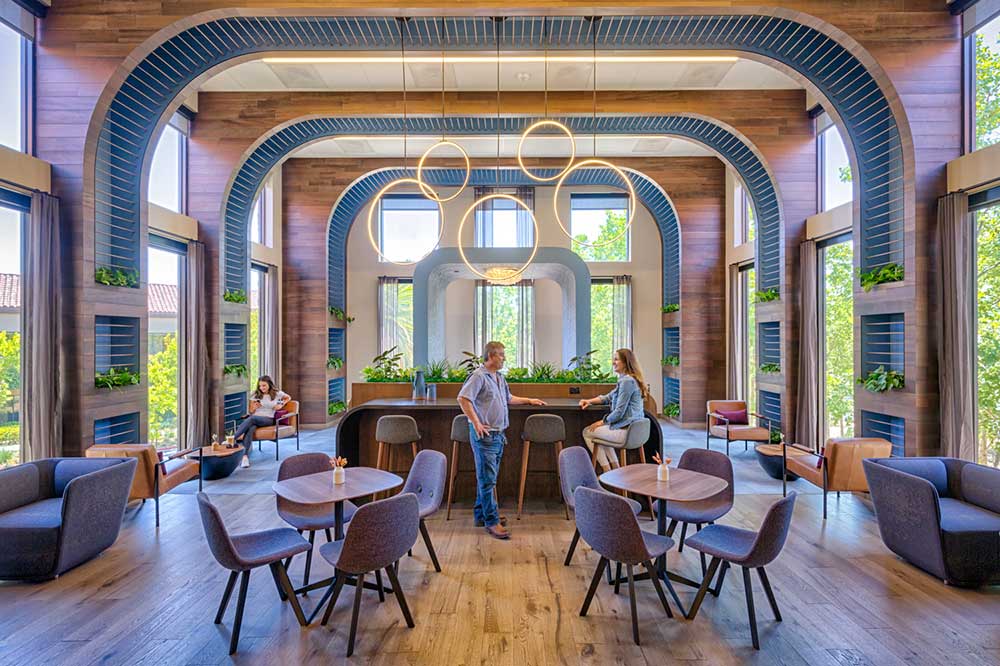
Workplace design is an area in which Maggie specializes, along with education, healthcare, and civic and cultural projects. In this project for a global technology client, she was one of the interior designers and a model for the photoshoot!
What are the biggest influences behind your design philosophy?
Honestly, my philosophy has developed over time. Each project and client has helped shape it. To me, great design starts with listening — really understanding who will be in the space, what their needs are, and what will make their days better. Whether it’s the flow of a workspace, the comfort of a classroom, or the calm of a healing environment, it’s about creating places that respond to people on a human level. There’s nothing quite like seeing an idea come out of listening and sketching, and then seeing it come to life — it’s such a motivating feeling.
Having worked with a wide range of clients, over time, I’ve come to see design as a bridge — connecting vision and function, emotion and purpose. It’s about crafting spaces that tell a story and support the people within.
Tell us about one of your favorite projects.
I’d have to say the Montana State University College of Nursing projects are some of my favorites. What has made them so meaningful is knowing how important they are — for the university and students as well as for communities throughout Montana.
The goal was to modernize and expand nursing education statewide, so we designed five campuses to be located in Billings, Bozeman, Great Falls, Kalispell, and Missoula, each with its own character but all tied together by a shared vision. We wanted the spaces to be bright, inspiring, and deeply functional for students — places where they could learn, collaborate, and grow.

Seeing these facilities come to life this year and into 2026 and knowing they’ll help train the next generation of nurses, is incredibly rewarding.

The first new Montana State University nursing education facility to open is in Great Falls, which celebrated its ribbon cutting ceremony in October.
When have your personal and professional passions aligned?
The Northern Lights Family Justice Center in Billings is one that’s really close to my heart. It’s a space designed to support women and families affected by domestic violence — people who deserve to feel safe, cared for, and empowered. It was one of our Cushing Terrell pro-bono design projects in 2024 and is currently being funded to be built.
The building hadn’t been updated in decades, so reimagining it as a calm, welcoming, and supportive place was such a meaningful challenge. In the early stages of design, we thought about even the smallest of details — the lighting, the furniture, the way people move through the space — to make sure it felt peaceful, warm, and human.
What are some of your passion projects at work or outside of the office?
At Cushing Terrell, I’m grateful to be part of a community that encourages creativity and connection. I’m involved in our Women In Action Employee Resource Group, the Design Excellence Creative Network, and our Mentorship Program.
Within the interior design industry, I’ve enjoyed serving as a past ASID board member, participating in the IIDA Rocky Mountain Chapter, and contributing to CIDQ educational outreach.
Locally, I’m proud to support the preservation of our community’s historic gems through my work with the Billings Preservation Society where I serve as Secretary of the Board and help advocate for the continued restoration of the Moss Mansion.
Whether I’m designing spaces, exploring trails, or paging through a good book, I’m happiest when I’m learning, creating, and connecting with people and places that make life meaningful.
A little more about Maggie…
I grew up in a magnificent canyon, spending most of my childhood outdoors helping my family run our recreational business as a concessionaire to the National Park Service. Those early years instilled in me a deep love for nature and storytelling, which carried into my young adult life as a park guide and interpretive ranger and further into my design career.
My family is the center of my world. My husband, Steven, and our two boys, Jack and Rhett, fill my life with laughter and adventure. We love longboarding, skateboarding, and rollerblading in the summer months, and when winter arrives, we switch to skiing, snowboarding, and ice skating.
I’ve always been drawn to history, fossil hunting, local trail hiking, and getting lost in museums. When I need a creative outlet outside of work, I turn to reading, writing, and sketching — it’s my way of blending my love for design and storytelling.


