How Technology Is Shaping the Retail Experience
Retailers have always known good customer service translates to repeat customers. Customer expectations — and the ways in which retailers address those — may have changed over time, but the philosophy of service and customer satisfaction is a constant.
While there’s clear evidence the retail industry is undergoing yet another transformation, one driven in large part by data, analytics, and emerging technologies, these tools can give retailers a clearer picture of what customers need, helping them respond faster and serve customers more effectively. For the designers and planners shaping those environments, they also open new possibilities for how stores are conceived, configured, and built.
In today’s environment, expectations have developed from customer service to the full spectrum of the customer experience. To embrace this more expansive view, retailers need information to shape and tailor the experience, and they’re using technology to accomplish that goal. This evolution was evident at the 23rd EuroShop, a global retail tradeshow, held earlier this year in Düsseldorf, Germany. With more than 81,000 visitors from 141 countries and 1,840 exhibitors from 61 nations, EuroShop 2026 underscored the global momentum behind retail environments that are both technology-driven and customer-focused.
Within the 14 exhibition halls, seven stages, and numerous networking and breakout areas, innovations shaping the future of retail — and responding to customer expectations — were on full display. Retailers are investing strategically by prioritizing efficiency, digital transformation, and the customer experience.
Navigating that landscape requires more than access to the right tools, however. It requires the expertise and foresight to know how and when to use them.
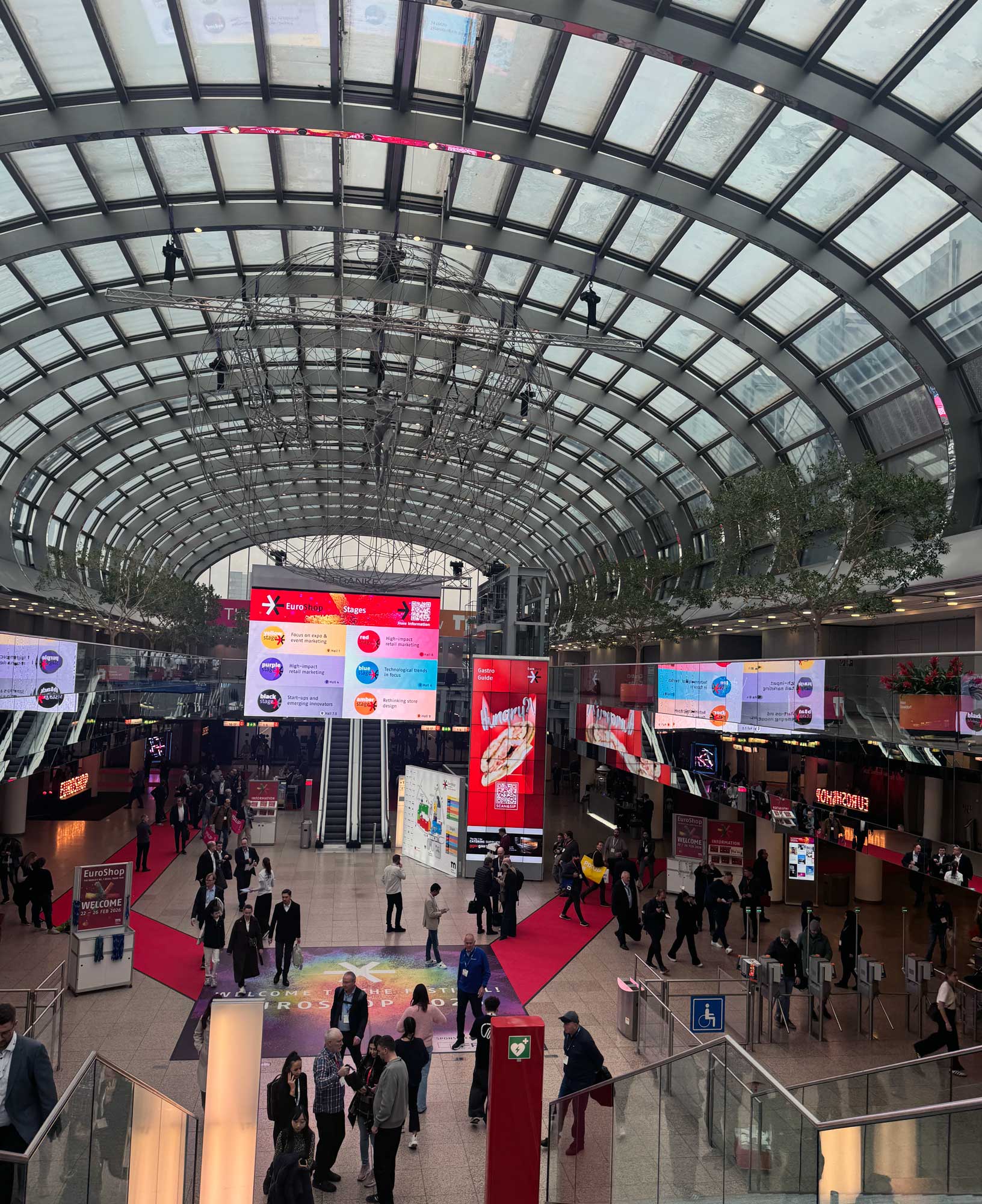
Overlooking the 2026 EuroShop hall in Dusseldorf, Germany
Designing From Reality, Not Assumptions
One tool retail designers are increasingly deploying is reality capture — using laser scanning (LiDAR), photogrammetry, and other spatial data acquisition methods — to produce accurate 3D representations of environments.
For existing stores, reality capture tools produce a “point cloud,” a dense collection of data points mapped in 3D space, which records everything visible with high precision. Think of it as a 360-degree snapshot of the store as it exists, product on shelves and all. In the case of a remodel project, retailers can walk through their space virtually, evaluate the layout shelf by shelf, and confirm where products should land before construction begins. The result is a store that feels intuitive to navigate, and puts the right products exactly where shoppers expect to find them.
In a recent project, we scanned a shell building in Texas to verify it matched the as-built drawings. Because the scan confirmed the mechanical, electrical, and plumbing (MEP) systems were installed as designed, the developer could move into the tenant fit-out with confidence, without the delays or costly surprises that come from discovering discrepancies in the field. Laser scanning is proving to be helpful not only for remodel projects but also for newly constructed buildings.
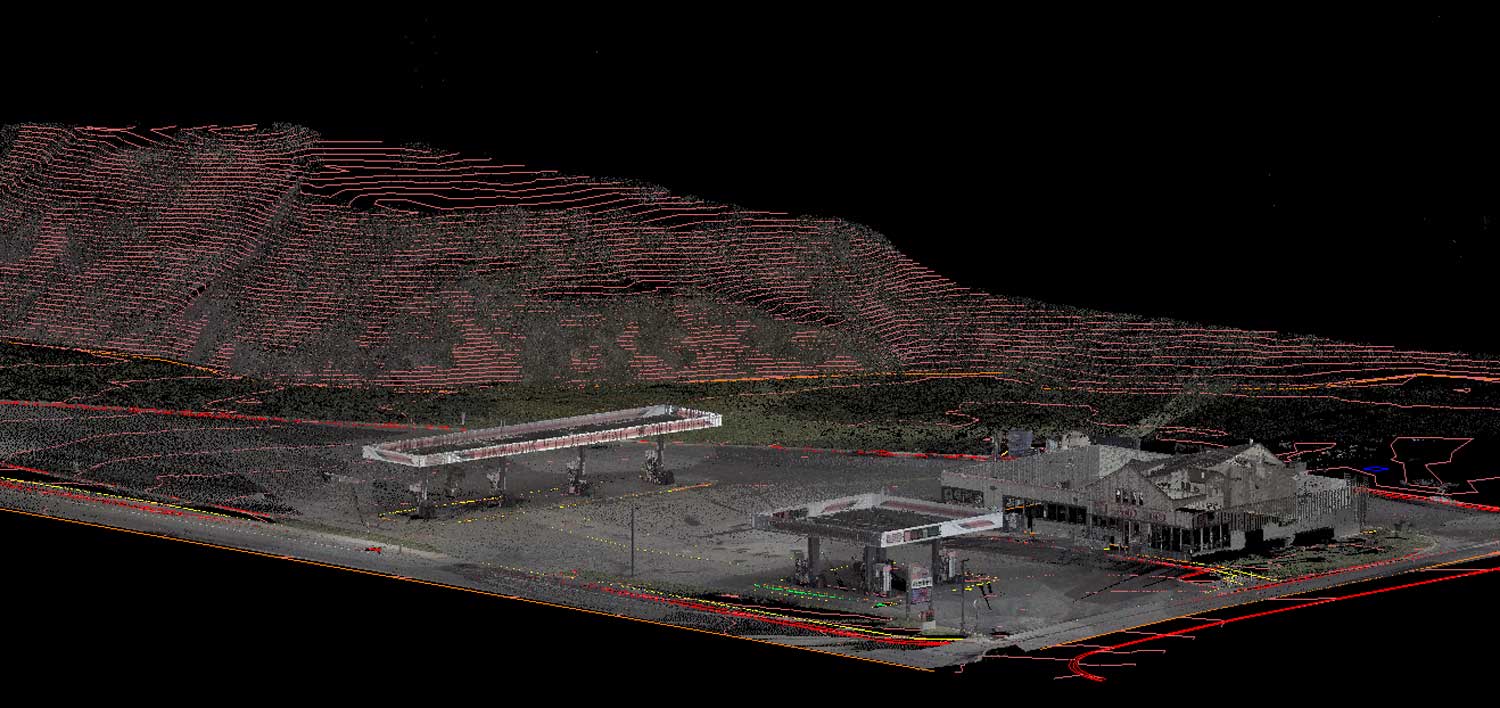
A site scan for a client’s project in Montana provided accurate existing conditions to support early-stage planning.
For new construction, reality capture data feeds directly into the digital modeling process, providing accurate site conditions that support early-stage planning, feasibility studies, and coordination among architectural, structural, and MEP systems. Documenting the site before design work begins captures grade changes, adjacent structures, and utilities that need to be accounted for before a single decision is made. Once that data is in hand, every design discipline can work from the same spatial reference, which reduces risk, minimizes rework, and results in a store that opens on time, ready to deliver the experience the retailer intended from day one.
Faster Decisions, Fewer Errors
We are currently developing an AI tool that back-checks client prototypes and standards against current designs and drawings. When a set does not match the current standard, the tool sends an alert, and the design team reviews the flagged issue, works through the discrepancy, and resolves it before construction drawings are submitted.
Automating that layer of review keeps our teams focused on what makes each project distinct: the design decisions that shape how a space feels and functions for the people who use it.
Self-Service as Customer Service
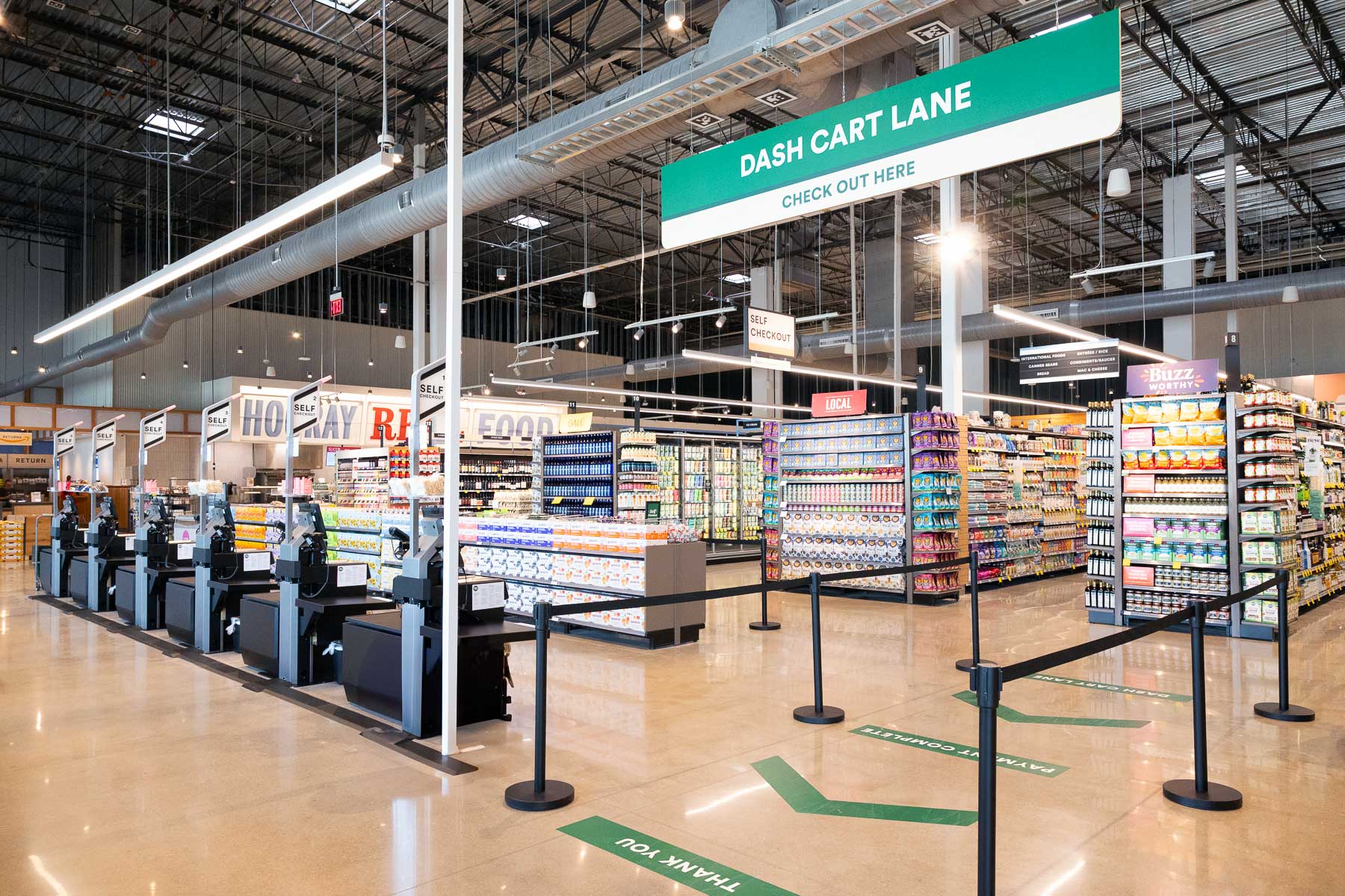
Grocery retail serves nearly every person, yet no two shoppers are alike. Store planners must design the customer experience around multiple shopper types, each with different behaviors depending on when and why they shop. A lunch break or after-work trip tends to be quick with a short list of necessities. A weekend visit may be longer with a fuller list or more time to browse. Designing for that range of needs means offering variety at the point of sale.
Oftentimes, speed matters. In the FMI U.S. Grocery Shopper Trends 2025 report, 55% of respondents said fast checkout was a very important attribute at their primary store. Self-checkout lanes have become one of the most common responses to that demand. They help store owners manage staffing and labor constraints while giving shoppers who are buying just a few items a faster path out the door. The same report found that 35% of respondents considered self-checkout lanes very important, reflecting how this option has moved from novelty to expectation among some shoppers.
The ideal strategy, for check-out lanes or any other point in the visit, is to allow shoppers to choose how they move through the store.
Forward From Here
A key takeaway from EuroShop, and something we see every day with our clients, is the industry’s continuous willingness to embrace change. Whether it’s investing in updated systems that are tried and true or embracing new technologies, the retailers who are best positioned for what comes next are those who treat every design decision as a customer experience decision and work with design partners who do the same.