Assessing the Options: How Higher Ed Is Accommodating Growth via Adaptive Reuse, Renovation, and New Builds
Across the nation, college enrollment rates are rebounding from the low levels seen during the pandemic, and they continue to grow — in particular for community colleges and four-year public universities.
One such example is Montana State University (MSU). Over the last five years, MSU has experienced record-breaking growth, reaching a peak of 17,165 students in fall 2025 and marking 10.2% growth in full-time equivalent enrollment, making it the largest university in the surrounding four states, including Wyoming and the Dakotas.
With this kind of growth, higher education institutions have decisions to make. How do they expand while being considerate of community needs, preserving historic landmarks, and meeting changing workforce demands? What’s the ideal option based on current building and campus configurations, land availability, strategic growth areas, and budget constraints? How do they best respond to economic and market fluctuations?
Below are examples of how a few of those colleges and universities have utilized different approaches to expansion. For each set of circumstances, here’s how we partnered with our clients to utilize adaptive reuse, historic preservation, renovation, and new builds to meet those needs.
Romney Hall’s Adaptive Reuse Story
Montana State University’s Romney Hall is a historic building on the university’s campus in Bozeman, Montana. While a beloved landmark (constructed in 1922 and listed on the National Register of Historic Places), the outdated and underutilized building had become obsolete for modern-day teaching and learning.
With steady student enrollment growth, every building on campus needed to be pulling its weight. Aligning with MSU’s committment to responsible development and understanding the special place Romney Hall has had in the lives of generations of students, the university chose to modernize and repurpose the 54,000-square-foot building.
Choosing adaptive reuse created the perfect blend of past and present. Built in the Italian Renaissance Revival style, the former physical education building boasts a tapestry-brick façade with terra cotta spandrels decorated with athletic motifs, large wood and steel windows, copper detailing, and a barrel-vaulted metal roof. The goal was to maintain these elements while making the building fully accessible, incorporating life-safety upgrades, optimizing energy efficiency, and maximizing square footage for classrooms and programs.
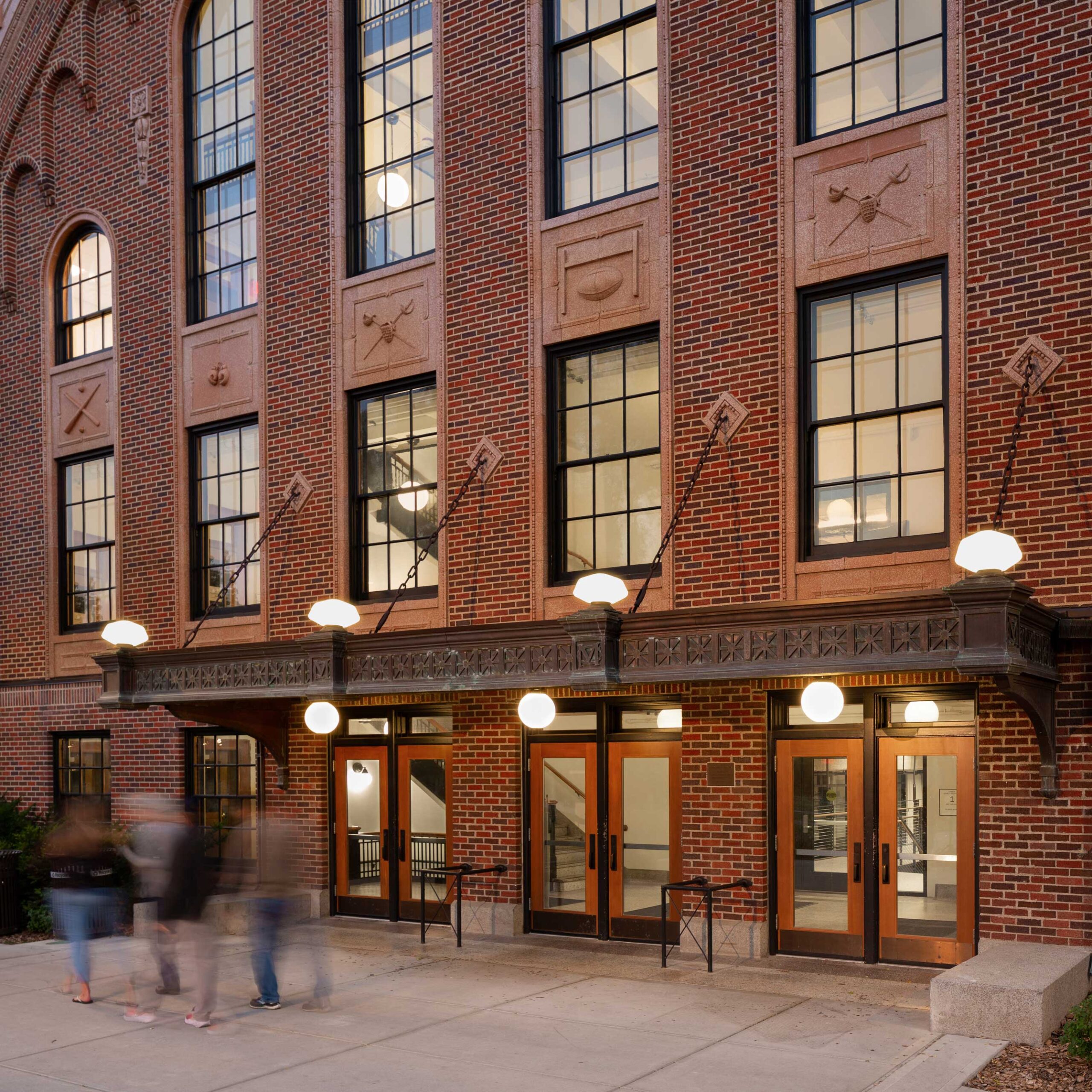
The renovation project called for specific and in-depth expertise to transform a building that once housed handball courts, a running track, a swimming pool, and a gymnasium into more than 1,000 classroom seats and 17 classrooms, as well as centers for math and writing, and services for veterans and students with disabilities.
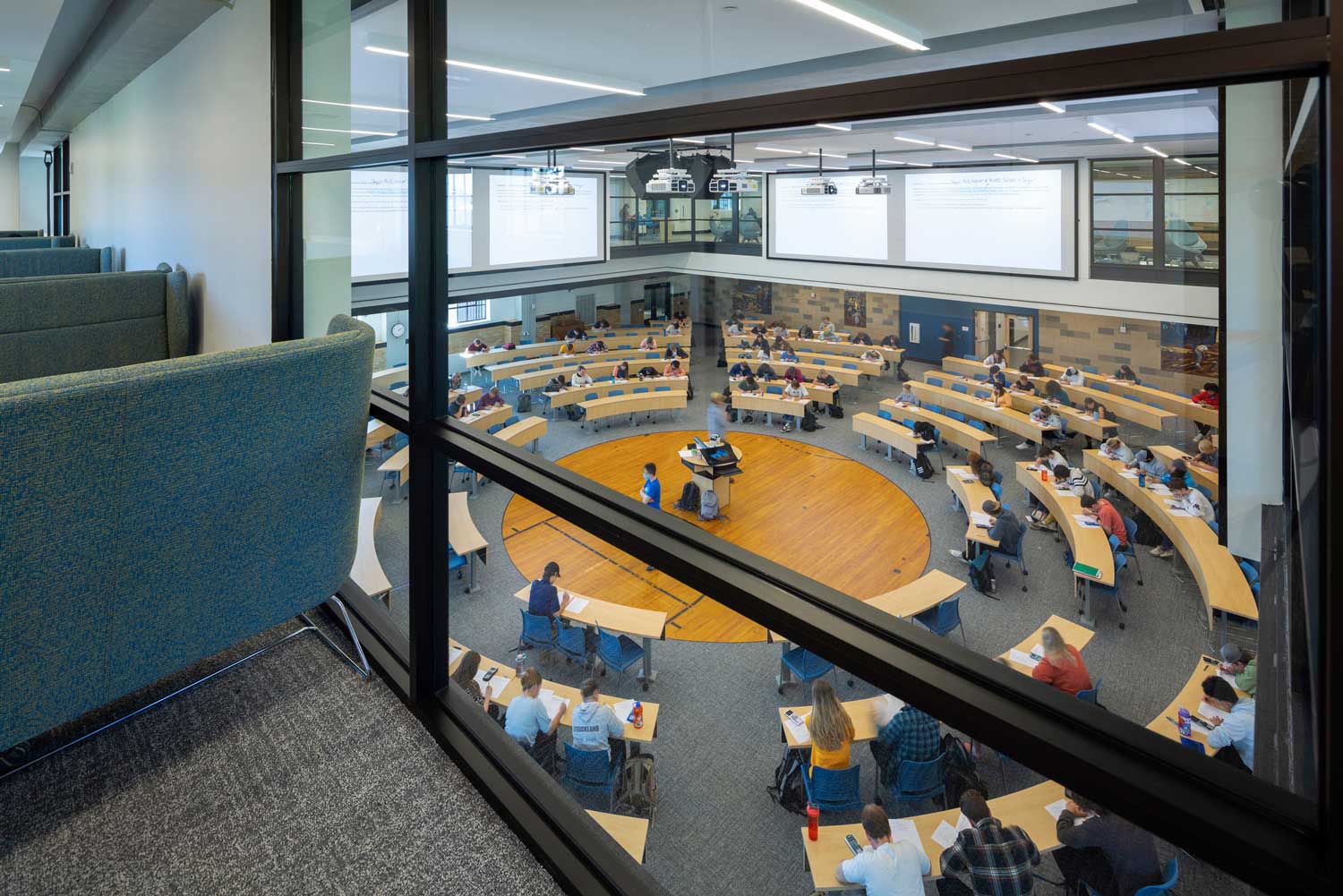
The renovation of Romney Hall incorporated variety of classroom types and sizes, ranging from 24-seat instructional rooms to a 300-person lecture hall that showcases a section of the former gym floor.
To create classroom space, the team addressed the issue of differing floor heights (due to the former athletic functions) by adjusting stair landings, grinding down floors, adding infill, and incorporating sloped floor transitions. To ensure structural integrity, the team strengthened foundation components to handle the new floor loads and incorporated seismic upgrades. This work created an additional 14,800 square feet of floor area within the building.
Additional tasks included modernizing the mechanical and electrical systems and maximizing energy performance by tying into an existing geothermal system and utilizing other creative strategies. To address both accessibility and energy performance, the team replaced the existing stair tower on the south side of the building with a new stair/elevator core addition. The elevator shaft is clad in dark-colored perforated metal panel, which captures solar-heated air that’s incorporated into the HVAC system, helping to reduce energy consumption and heating costs.
Accessibility was further enhanced by creating a new grade level passage through the building to connect the north and south campus areas.
A big benefit of adaptive reuse was seeing more than half of Romney’s building resources preserved and reused, including structural elements, enclosure materials, and interior elements. More than 2,300 tons of construction waste were recycled and/or reused.
Romney has been an incredible sustainability success in that we were able to reuse a 100-year-old building, transforming an iconic and historical structure into a premier teaching facility to serve students for decades to come.
John How
Associate Vice President for Montana State University Services
Post renovation, Romney Hall is not only one of the most utilized buildings on campus but also earned LEED Gold certification for its sustainable design solutions.
TVCC Readies Students for the Workforce via Building Renovation and Addition
Located in Ontario, Oregon, Treasure Valley Community College’s (TVCC) Career and Technical Education (CTE) Center is an immersive, hands-on learning facility. With the region’s high demand for positions in agriculture, natural resources, automated systems, and fabrication, TVCC provides students with specialized skills and training to excel in those fields.
To modernize and expand the CTE Center — to meet growing demand for the programs — the Cushing Terrell team designed a 12,000-square-foot addition along with renovations to the existing 15,000-square-foot shop facilities.

An expansion and renovation project at Treasure Valley Community College in Ontario, Oregon, created a new Career and Technical Education Center designed to support specialized hands-on training.
This experiential learning environment is not your average classroom or shop. The layout is student-centered, technology enriched, and includes labs, workshops, project and demonstration areas, and spaces for fabrication, experimentation, and research and development.
One of the big priorities of the project was to ensure the learning spaces have the flexibility to evolve with changing school, student, and workforce needs. Because of this, incorporating adaptability was key — from moveable furniture to multifunctional overhead doors that create a frictionless transition between classroom instruction areas and hands-on activities outdoors.
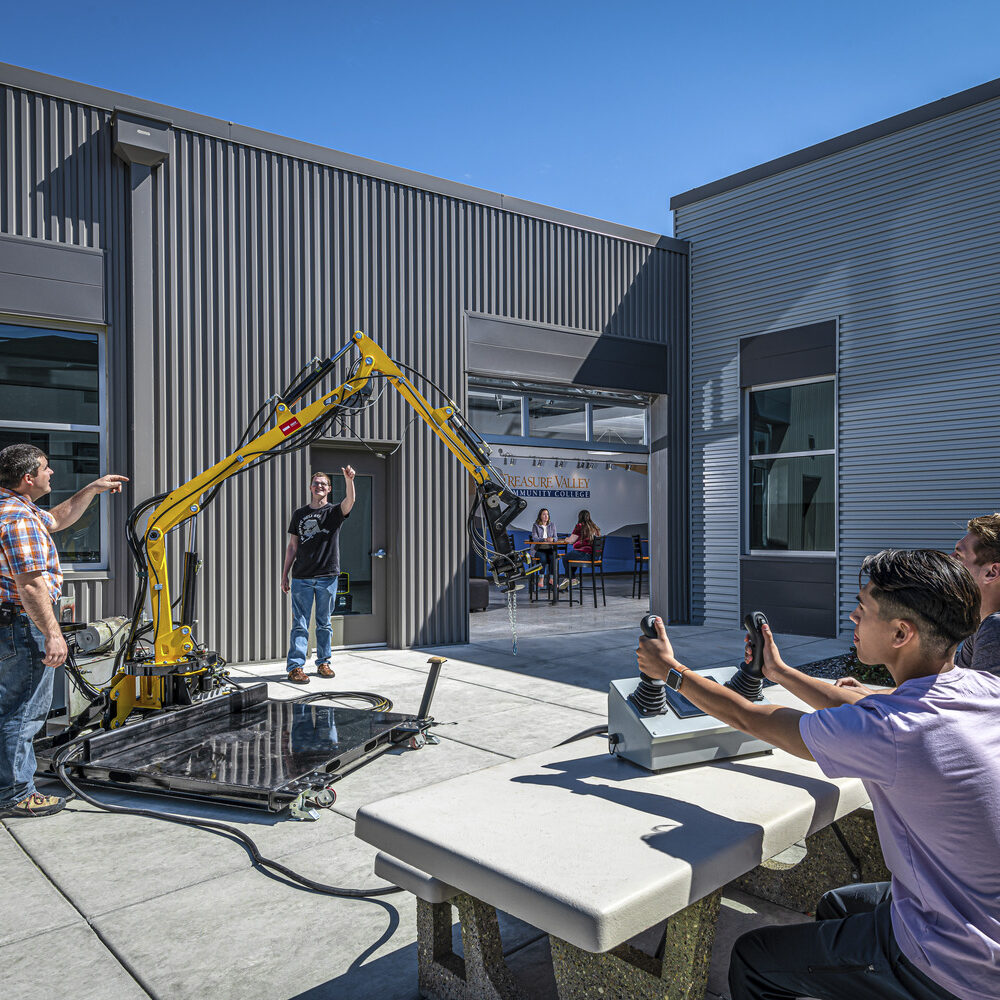
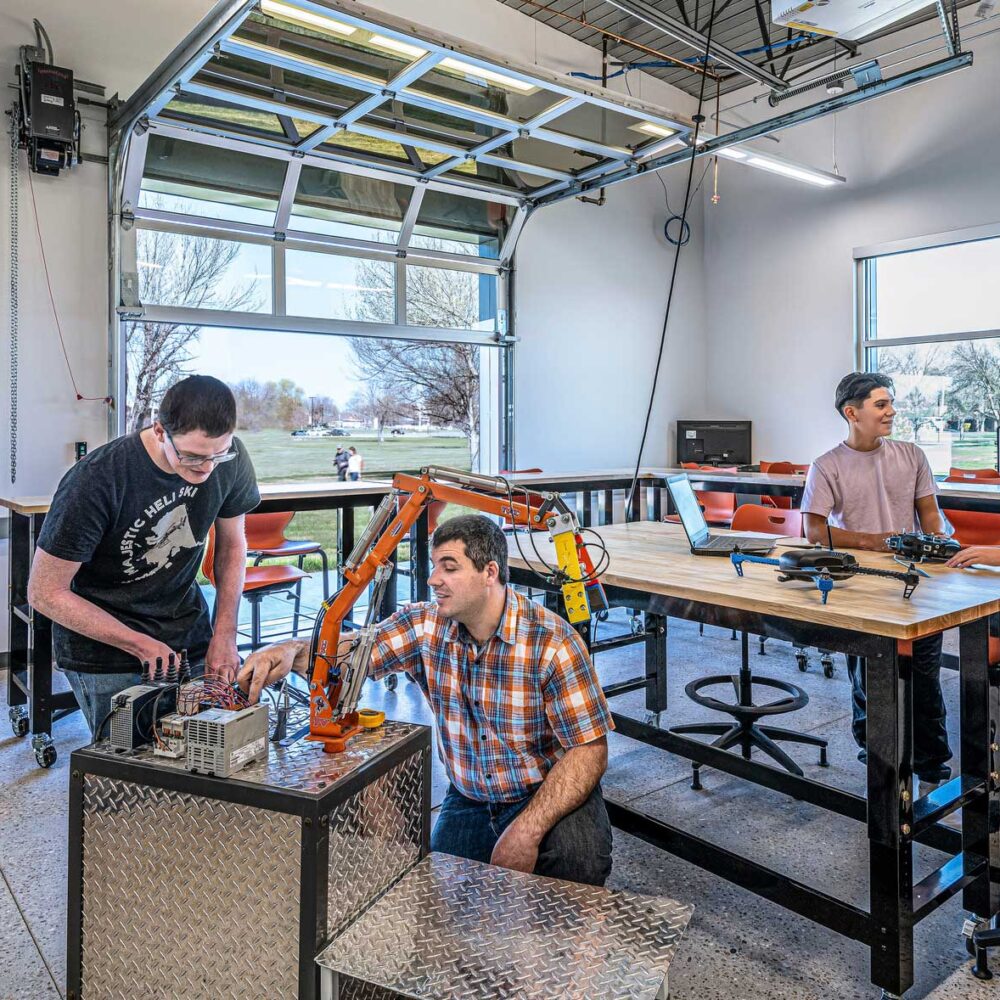
The theme and desired experience identified by the client was “learning on display,” which heavily influenced the visual design as well as the open concept floorplan and interaction between spaces. This theme was enhanced with a new common area that’s the heart of the building and is connected by a long lobby with entrances at both ends that welcome community members and students with comfortable seating, high-top tables, and whiteboards. Student projects and achievements are displayed in the lobby shadow boxes, labs, and shops.
Cushing Terrell also worked with TVCC on a solar panel array, which provides the center with renewable energy, helps lower power costs, offers self-sufficiency in alignment with their autonomy and evolution goals, and serves as a demonstration project for their renewable energy programs.
Choosing to add square footage and upgrade the original building meant the team could incorporate a variety of design solutions to support mindful use of resources and student health and wellness. For example, a welding exhaust was replaced with a recirculating dust collection system, which is safer for welders and uses less energy. Low-water-use appliances were prioritized, along with condensing gas water heaters. Energy and daylight modeling were used to find solutions to minimize energy use and maximize natural daylighting, as well as to reduce potential glare in classrooms.
FVCC Wows with New Performing Arts and Athletics Building
Founded in 1967 in Kalispell, Montana, Flathead Valley Community College (FVCC) was envisioned as an educational resource for people in the region who wanted an alternative to a four-year university degree.
According to the FVCC website, “A study conducted in 1959 showed that only 20% of Flathead High School graduates were pursuing higher education. [Community members] were determined to create a local higher education option for Flathead Valley students.” And over the 60 years since its inception, FVCC has established itself as a reputable, reliable, and forward-thinking institution.
When FVCC came to Cushing Terrell, they were ready to push the envelope further and create something unique that would be a standout feature for the college. Their vision was for a world-class performing arts and athletics venue that would enhance the student experience, serve as a cultural touchstone for locals, and be a destination for out-of-town visitors.
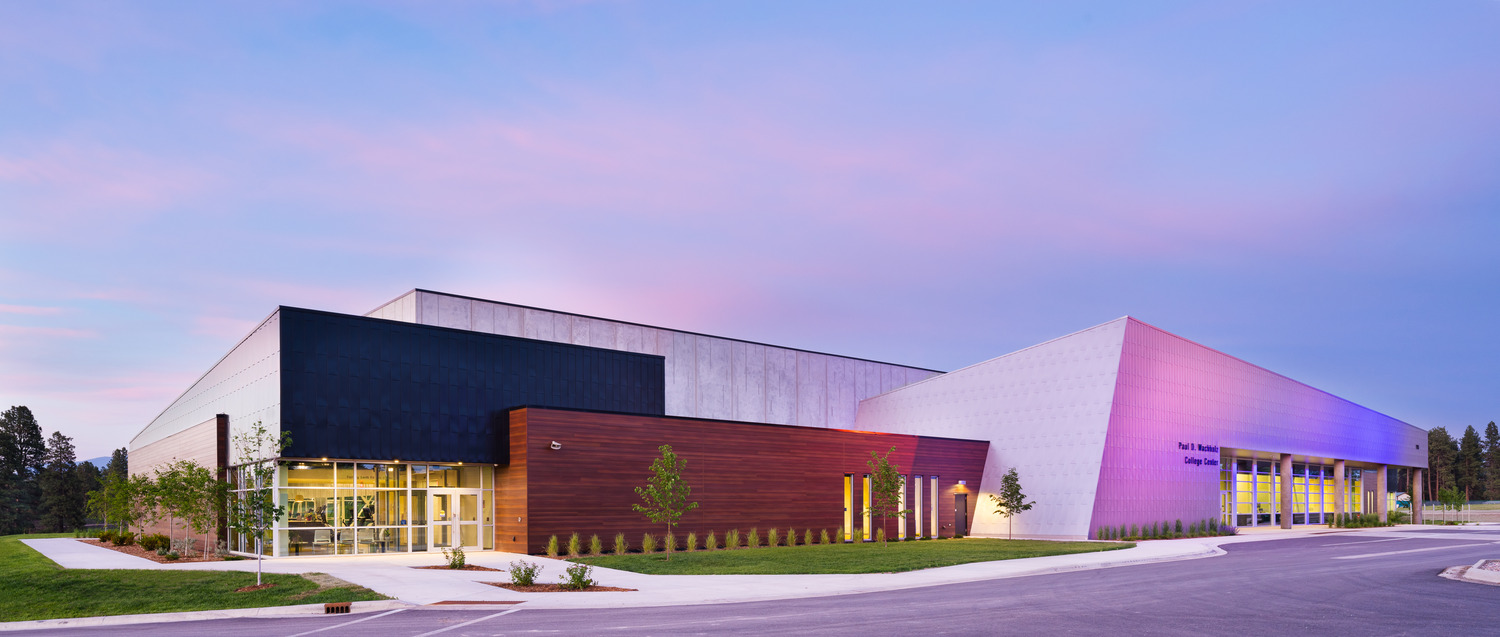
The Wachholz College Center combines two distinct venues into one stunning building on the Flathead Valley Community College campus.
With adequate land to spare on the FVCC campus, the design team used the interesting features of the site itself to shape the new building. The facility is built into a steep hill and is adjacent to an existing parking lot. The ability to utilize the parking lot (performances tend to be in the evening, while classes are during the day) was a significant benefit of the location while building into the hillside kept the front entrance at a scale that fits in with the rest of the buildings on campus.
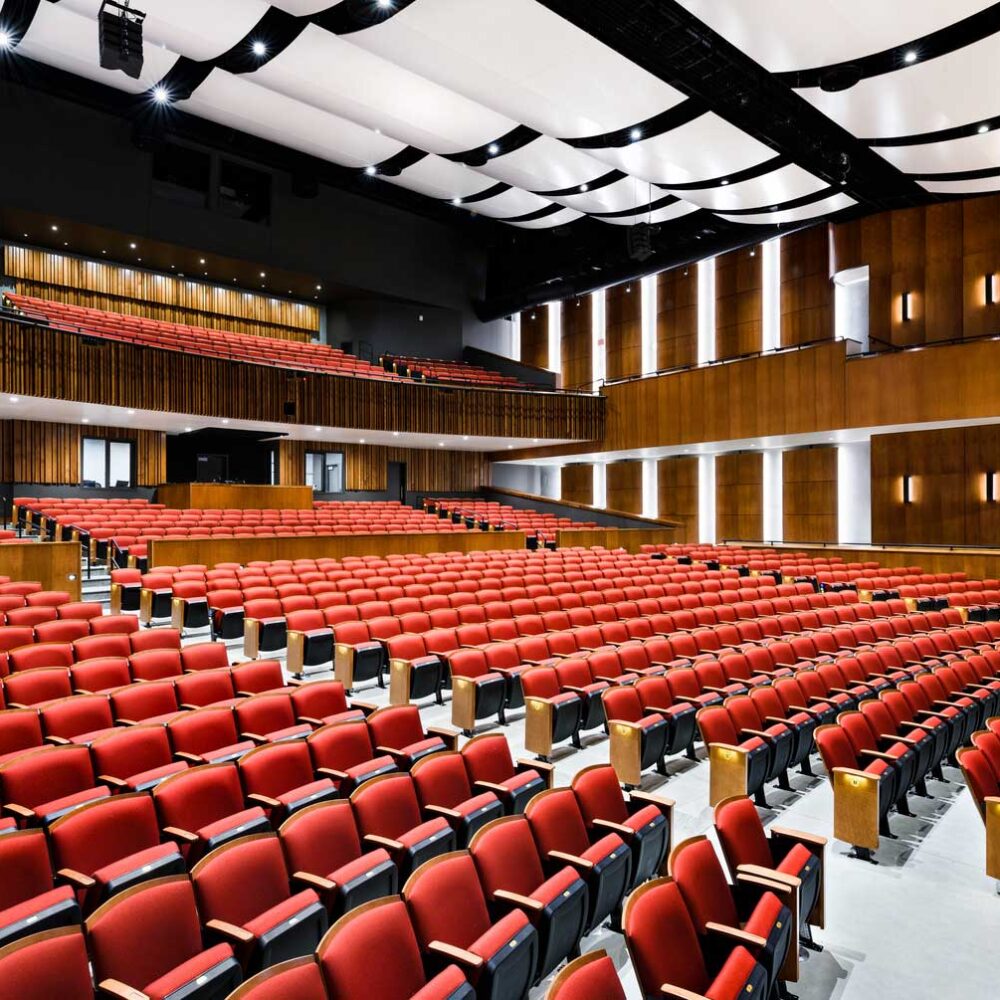
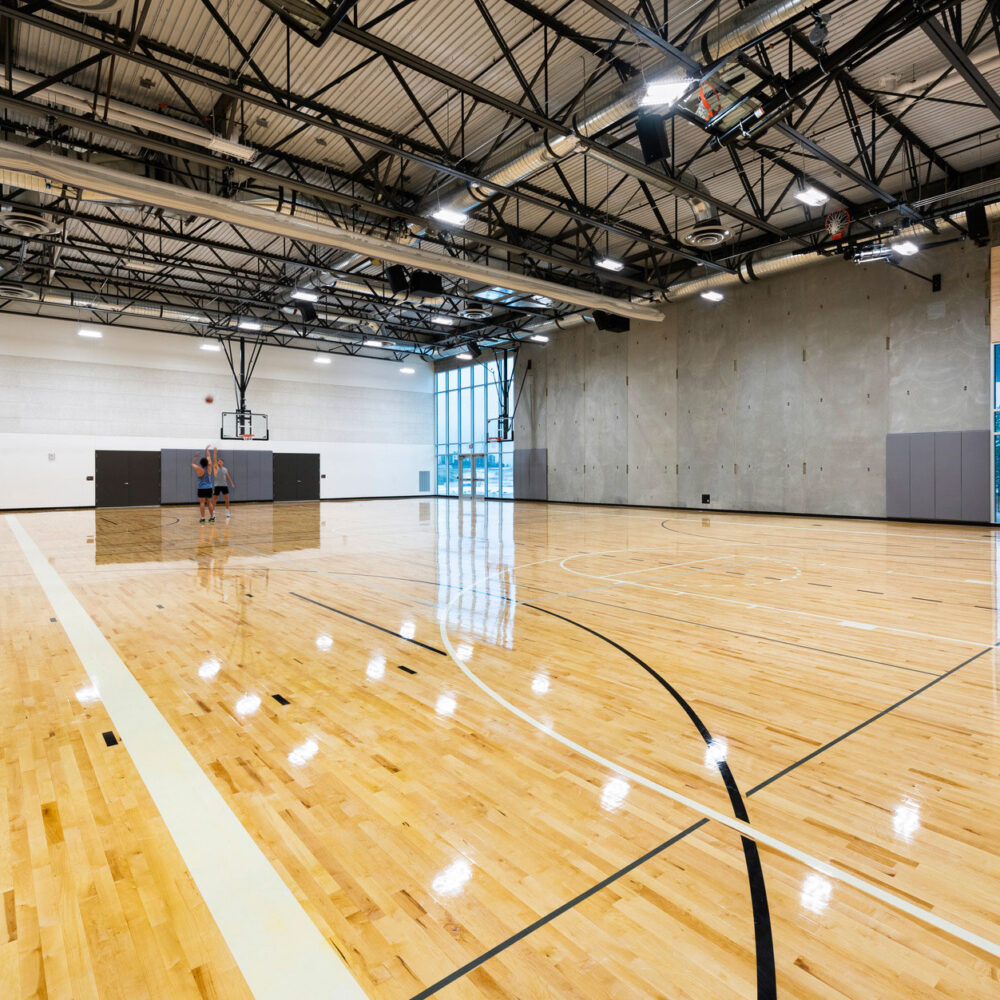
What resulted was the 67,000-square-foot Wachholz College Center, which has two wings. The first houses McClaren Hall, which features a 1,000-plus-seat performing arts center with state-of-the-art acoustics and flexibility to accommodate concerts, lectures, dance performances, and musical theater productions. The second houses Stinson Family Event Center, which comprises a dual-court gymnasium, a fitness center, and flexible health and wellness space for classes. A reception hall and art gallery connect the two wings while an outdoor amphitheater rounds out the performance and gathering spaces.
The Wachholz College Center has been a game changer in terms of being able to bring world-class talent and a variety of concert tours to the Flathead Valley. We’ve heard time and time again that the overall experience of attending a performance at the Wachholz College Center rivals that of most ‘big city’ performing arts centers, and many patrons comment that they cannot believe they’re still in Kalispell once they step inside the exquisitely designed venue.
Matt Laughlin
Wachholz College Center Director
Reinvigorate Your Campus
Well-designed, contextual educational facilities that meet current and future needs are not only critical for student success but also have cultural and historical significance for our communities. They’re where the next generation of students go to learn and hone their skills as well as hubs for art, creativity, innovation, culture, athletics, and civic identity.
As vocational landscapes and modern necessities change, these facilities must be able to adapt and stay relevant. To think, many campuses across the United States have operated under the same roofs for over a century. However, with thoughtful planning and design, these older structures can continue to add value while grounding and complementing newer structures.
With the goals of supporting workforce needs, making accessible spaces for all styles of learning, preserving culture and identity, and ensuring the needs of higher education for generations to come, our multidisciplinary design team at Cushing Terrell aims to find the best solutions for each education client. No matter what your needs and budget are, or the potential economic and market circumstances at the time of our project, there are a wide range of options and improvements to explore, and our education design team can help you figure out the best path forward. Contact our team.